
Hospitals waste medication every time a patient moves.
When patients transfer between units, the medication already dispensed for them often can’t safely travel with them. So it’s discarded — and re-ordered at the next stop. Multiply that by every transfer, every day, and it becomes one of health care’s quietest, most expensive habits.
The scale of waste
Figures describe the broader medication- and health-care-waste problem MedBed is designed to help address. See Sources.
Why it persists
It isn’t carelessness. When a patient moves, safety and liability rules mean their medication has to be re-verified at the new location — and today there’s no simple, secure way to move already-verified medication with the patient. So the safest-looking option for busy staff becomes “discard and re-order.” That default is exactly what MedBed removes.
What it costs
Hospitals pay in wasted medication, wasted pharmacy and nurse time, and repeated verification at every transfer.
Patients pay in delayed doses, higher bills, and the risk of medication being lost or duplicated in transit.
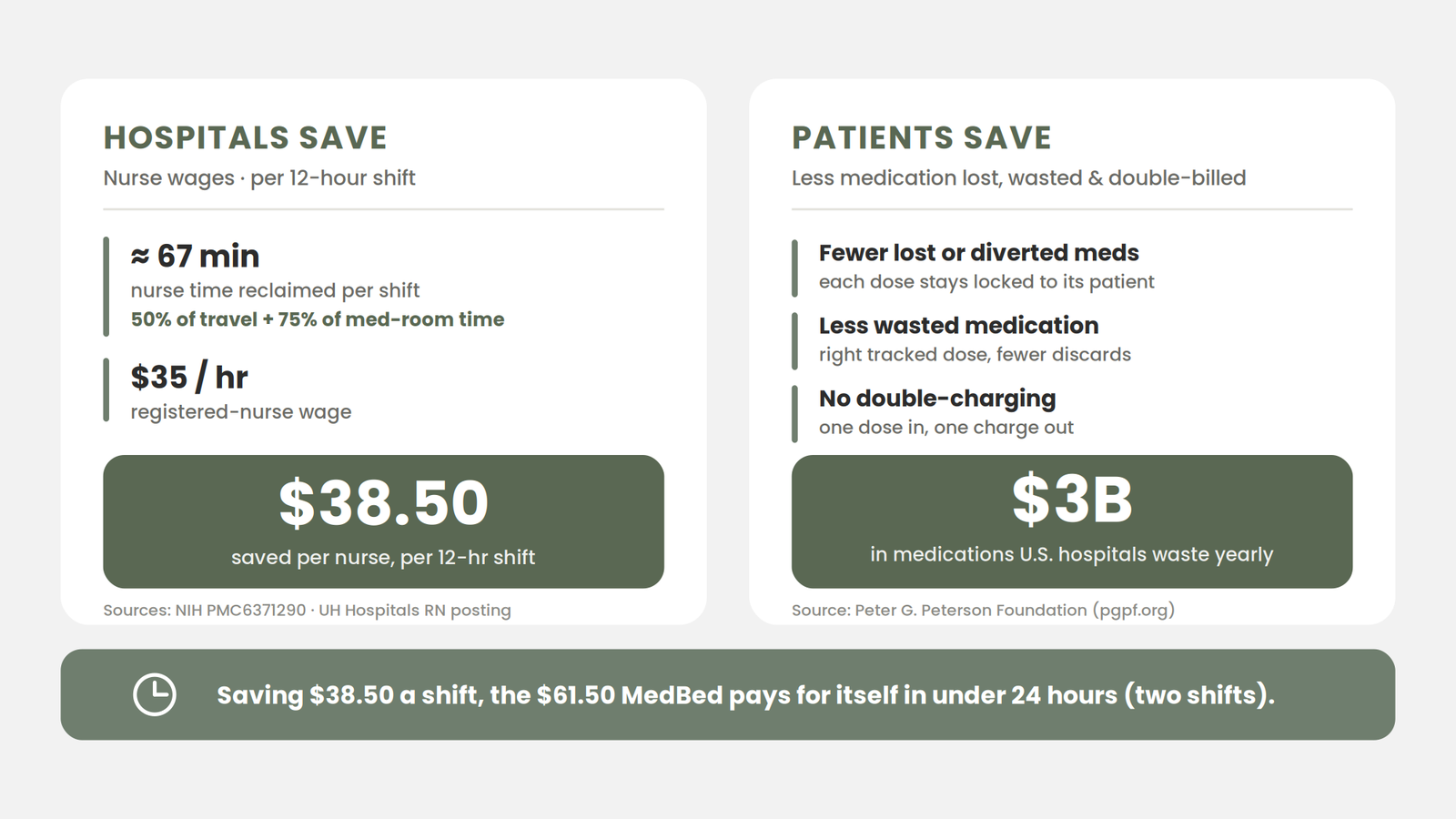
The two sides of the savings — for hospitals and for patients. Internal estimate; see Sources for methodology.